
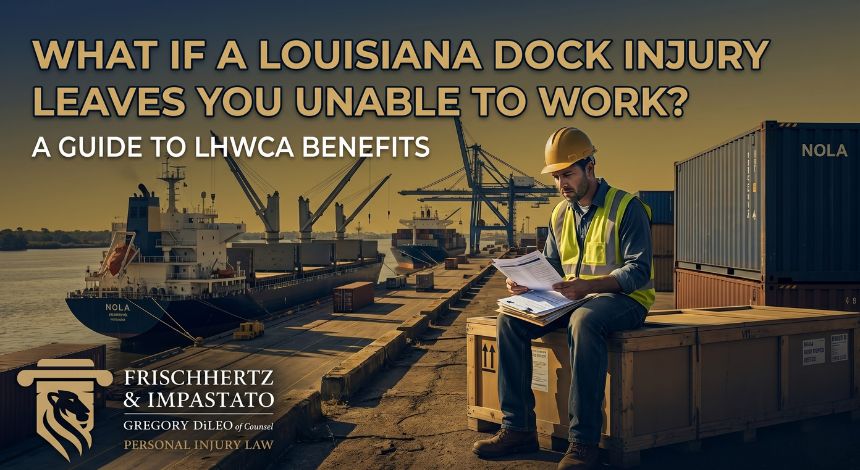
A serious dock injury does more than damage your physical health; it immediately threatens your family’s financial stability. If your job involves loading cargo, operating heavy equipment, or working around vessels along the Mississippi River or the Gulf Coast, a single accident can suddenly sideline your career.
When the physical demands of waterfront work become impossible to meet, you need to know exactly how the law protects your income and your future.
LHWCA vs. Louisiana State Workers’ Compensation
A common point of confusion for injured waterfront workers is figuring out which system handles their claim. If you are hurt on a dock, pier, wharf, or dry dock in Louisiana, you are likely covered by a federal law known as the Longshore and Harbor Workers’ Compensation Act (LHWCA) rather than standard state workers’ compensation.
To qualify for LHWCA benefits, your claim must meet two specific legal tests:
-
The Situs Test (Location): The injury must occur on, near, or adjacent to navigable waters. This includes adjoining piers, wharves, dry docks, and terminals used for loading, unloading, or repairing vessels.
- The Status Test (Occupation): Your employment duties must directly connect to maritime activity. This systematically covers longshoremen, harbor workers, ship repairmen, shipbuilders, and vessel loaders.
Because the LHWCA generally provides significantly higher weekly wage replacement benefits than standard Louisiana state workers’ compensation, identifying the correct jurisdiction immediately is vital to your recovery.
Understanding Your LHWCA Benefits
If your dock injury keeps you from earning your usual paycheck, the LHWCA provides critical financial and medical safety nets to keep your household afloat:
- Medical Care: Complete coverage for all necessary medical treatment, surgeries, prescriptions, and rehabilitation related to your maritime injury, with the right to choose your own treating physician.
- Disability Compensation: Financial compensation based on your Average Weekly Wage (AWW). For total temporary disability, this generally equals two-thirds of your average weekly earnings prior to the accident.
- Vocational Rehabilitation: Specialized services and retraining support if your lasting physical limitations permanently prevent you from returning to heavy dock work.
Medical Restrictions and the Pressure to Return Early
Following a severe injury, your treating doctor will establish written work restrictions. Whether you are prohibited from lifting heavy loads, climbing ladders, standing for long periods, or operating heavy machinery, these restrictions are legal proof that returning to your old position is not realistic.
Unfortunately, many injured longshoremen experience intense pressure to return to the waterfront before their bodies have fully healed. This pressure often stems from mounting household bills, employer crew shortages, or an underlying fear of losing steady employment.
Important Legal Note: Returning to light duty or full duty too soon can cause permanent medical setbacks. If your employer offers a light-duty position, it must strictly accommodate the explicit medical limits written by your doctor.
Documenting the True Impact on Your Income
To secure the maximum benefits you are owed, you must look beyond your basic medical chart. You should actively track and document every single way the injury alters your daily working life:
- Detailed logs of missed shifts, lost overtime opportunities, and forced reductions in your hours.
- Specific notes on physical pain, structural weakness, or loss of mobility during routine daily tasks.
- All written communication, text messages, or emails from supervisors regarding your return-to-work status.
Before you sign any settlement papers, agree to return to light duty, or accept a modified position, you must understand the long-term impact on your career.
Contact a New Orleans Maritime Injury Lawyer
Navigating the intersection of federal maritime law and insurance company timelines is incredibly difficult when you are trying to heal. The insurance adjusters know the rules, and you deserve an experienced legal team that knows them better.
With over 75 years of combined legal experience and more than $700 million recovered for our clients, the attorneys at Frischhertz & Impastato understand exactly what it takes to protect Louisiana maritime workers. We protect your right to proper medical care, accurate wage calculations, and long-term financial security.
If you or a loved one has been injured on a New Orleans dock, wharf, or vessel, do not leave your future to chance. Call Frischhertz & Impastato today at (504) 264-9915 or visit our office at 1140 St Charles Ave for a free, confidential consultation. We are here to help you get your life back on track. Get started today by requesting a Free Consultation online.